Story
Listening to Someone Who Listens: Your Are Not Alone With Paul Jenkinson
Stephanie Jones
about 2 months ago
A Cross-Canada Journey of Presence, Connection, and Hope
In a culture full of noise, opinions, and constant commentary, listening has quietly become rare.
Paul — a retired social worker with four decades of experience — is doing something both simple and radical. He travels across Canada offering free listening sessions to strangers. No agenda. No cost. No advice unless asked. Just presence.
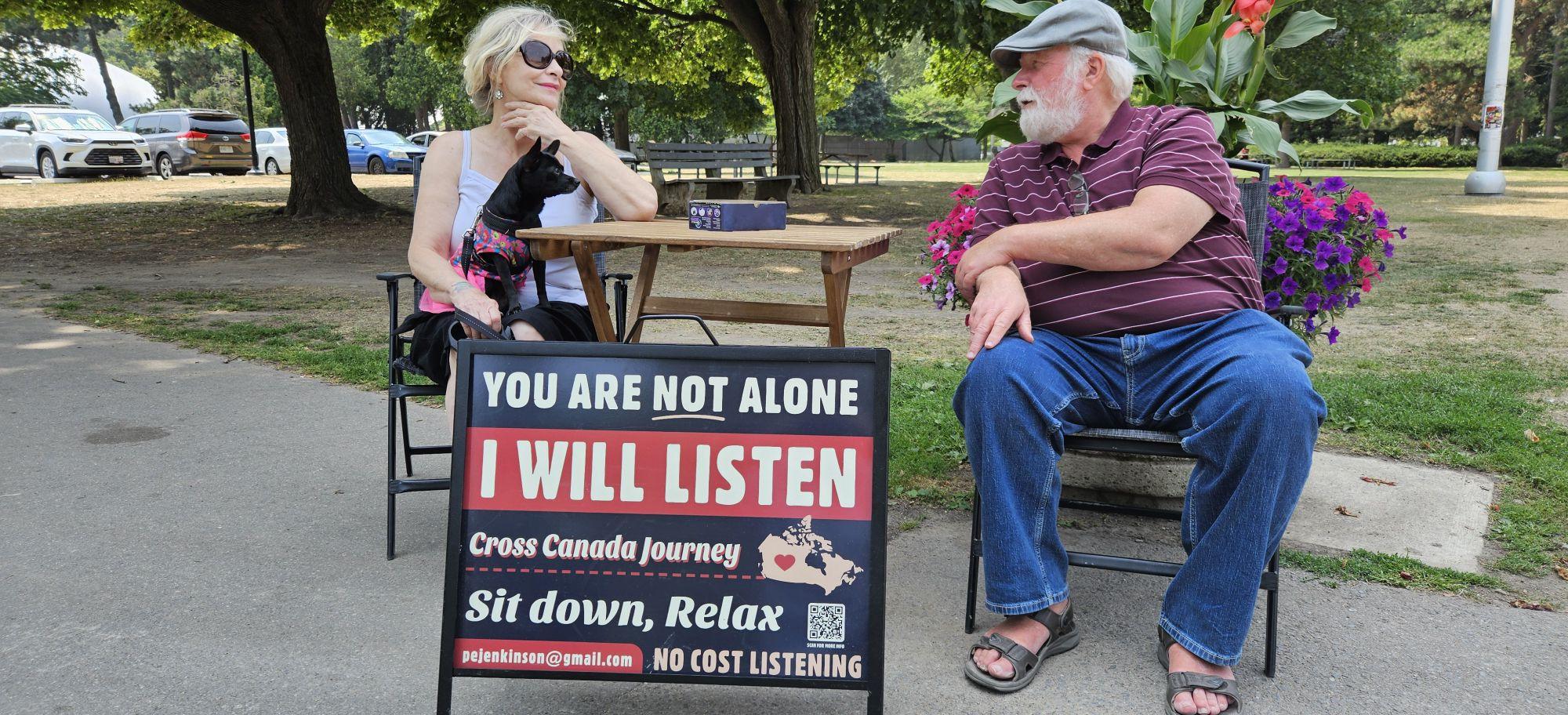
His sign says it plainly: “You Are Not Alone. I Will Listen.”
What follows are Paul’s words, shared exactly as he offered them — an invitation into a journey rooted in listening first, listening longer, and meeting people exactly where they are.
What led you, as a retired social worker, to begin offering free listening sessions to strangers?
“I feel a responsibility to my fellow citizens, humans in general and so as a then 70 year old retired Social Worker, with 40 years experience and two degrees I wanted to offer that knowlege and experience treasure, without cost.
The idea of No Cost but particularly the idea of Listening First and Listening Longer came from a deficit I was perceiving in our very chatty, word based culture.
Listening starts with the other person, with a desire to give them a safe space, with no judgement, no shaming, a place where they are held with Unconditional Positive Regard (Carl Rogers) and in that space I imagined wonderful, healing moments occurring all across Canada.
Listening to others would also allow me to explore Canada one more time.”
Was there a moment that made you realize this kind of presence was needed?
“In my career, the highlights, the golden moments all were rooted in the times of human connection and transformation, when the person I was with felt, seen, heard, understood, appreciated, enough, not flawed, acceptable, and in that loving space growth and change and... happened.”
How do you usually introduce yourself and your purpose to people you meet?
Paul’s introduction often begins before he says a word.
“My sign which says ‘You Are Not Alone’, it also makes a Promise ‘I Will Listen’ and states there is an adventure happening here ‘Cross Canada Journey’. The sign is the first point of introduction.
I do all sorts of different Bridge building initiatives between myself and complete strangers walking by.
I often say hi how are you and if and after they respond they will often ask how I am. Their question gives me permission to say I am great, I am on a journey across Canada Listening to people. I then talk for 3 minutes about my journey, my qualifications, my Commitment to Listen to them, Listen Longer, without judgement etc.
I also offer dog treats and when I have my head down feeding the dog, I encourage the dog while also sharing the purpose of my journey to their human companion.
I share Jolly Rancher Candy with children, with the permission of parents, and to the delight of teens who immediately connect to an old man who knows what their favorite candy is.”
What does a listening session typically look like for someone experiencing it for the first time?
“I will ask a person if they have a story from their life ...or I may ask what would you like to talk about or if they seem unable to start I might ask them if they have some wisdom, something they have learned in life, something that is keeping them on a good path.
The guest is in control of the Listening Opportunity. I offer the occasional prompt or clarifying question but primarily Listen as they begin to examine the human situation they are experiencing.
When they bring joyful news, thoughts or memories we celebrate those. My two chairs, a table and a welcome sign is often quite a happy place with lots of laughter or at least amused chuckles about life and our responses to it.
My goal is to meet the person exactly where they are, to be entirely present with them with no agenda other than recognizing their real strength, qualities and the answers they surface.
Each guest is enough. Each guest inherently knows at least the next possible step forward.
When they leave, my observation has been that they often appear visually more erect and emotionally lighter.”
What do people seem most surprised by when they realize you’re simply there to listen?
“They are surprised that there is no hidden agenda, no financial transaction, no bait and switch wherein I promise them safe Listening but change to dogmatic spiritual or political statement making.
They are also surprised when I tell them that I am committed to like them at the beginning of the conversation and I will like you at the end of the conversation.
This promise makes sense when they realize that as the Listener practicing Unconditional Positive Regard I am all in on that way of being with people.”
Without sharing personal details, what themes or emotions come up most often in the stories you hear?
“I am hearing the human themes of love, loss, the celebration of being seen and understood, the pain of being misunderstood, abandoned, across every age group and stage of life.
The joys of parents and children able to attach, to experience the world as safe and loving and caregivers, lovers, friends, attuned and responsive to our needs.
The deep wounding that occurs when that was not provided in childhood and the surviving, thriving and even flourishing if we find healthy people, insightful philosophies and psychological concepts and spirituality that feeds our deep needs.”
What have these conversations taught you about loneliness and connection in Canada today?
“It seems that there are as many ways to yearn for human connection and to grieve disconnection as there are people.
In Canada the need for Covid era bubbling up has lead to some folks having a difficult time reentering public spaces and larger group activities.
The culture people came out of Covid into is much more electronic and the use of cellphones, tablets, earbuds, in public spaces, has lead to either acceptance of a culture where each person moves through life in a self constructed and protected bubble or the challenge of making a connection, between strangers, in social spaces, in the service of fostering relationship, connection, and group cohesion, even among strangers.”
How do people usually feel at the end of a session?
“My observation is that people feel emotionally lighter, more able, affirmed, respected, less damaged or unacceptable, honored, celebrated, known, a neighbor no longer a stranger, possible a person who has experienced ‘love your neighbor’, by knowing, really being known by a new neighbor.”
This work involves a lot of travel—how do you currently make it possible to continue across Canada?
“My trusty 2017 Subaru Forester has been a steady, supportive companion during the 30,000 klms of the journey. Thank you to friends like Evan who occasionally provide funds for oil changes and maintenance.
Each person or group that invites me provided Billeted Housing.
My gas and food expenses, car repairs, new tires and daily needs are covered by my modest pension and by about $1000.00 per month in GoFundMe donations on my You Are Not Alone, I Will Listen Cross Canada Journey Facebook page.”
Does the level of financial or community support you receive affect how often or how far you’re able to travel?
“No there have been no limitations so far. If people invite me to come, provide Billeted Housing, one meal a day and partner with me to find place to provide Listening Opportunities or do a presentation on my journey, then I am ready to go.
While my journey has been east coast to west coast it will now reverse direction, including responding to invitations from the Northern territories and ending in Newfoundland.
This is not a linear journey. If people invite me to a community 4 hours in my review mirror I will come. People rule not a commitment to always moving linearly.”
What keeps you going on the days when the road—or the stories—feel heavy?
“I think I have learned to always see the guest as the expert in their own situation. They are both capable and insightful about possible pathways forward in their lives.
I am at most an unexpected, loving, encouraging person who helps them explore the way while adding a little ‘elders’ wisdom gained by walking similar paths.
I have survived the death of an adult child, the dismantling of a Long-term relationship and other losses. I am wounded but not broken.
I see the possibility of rebirth and flourishing in every person.
People leave Listen Opportunities often saying in delighted surprise ‘I never expected that to happen’.”
If someone feels inspired by your work, what are the ways people can support you or help this work continue?
• “People can invite me to their village, town or city, provided Billeted Housing and one meal a day.
• People can imagine how to launch a similar Listening service in their community in a way that is a blessing, does not harm folks, and is sustainable.
• People can provide me with the names of Listeners in their community, people willing to sit with me and share their insights into how Listening and human connection is achieved.
• People can comment on my Facebook page offering their experiences and insights into what is becoming a community consultation on Listening as a Healing Initiative in our communities.
• People can visit my Linktree to learn about myself and the media reaction to my journey: https://linktr.ee/pejenkinson
• People can contribute to covering the journey expenses, beyond my Pension funds, by contributing to my GoFundMe.”
A Quiet Invitation
Paul’s work doesn’t ask people to change, fix themselves, or perform strength.
It asks only that they sit — and be heard.
In a world moving faster than our capacity to connect, his chairs remain open.
And his message remains steady:
You are not alone.
Join the Conversation
Sign in to react to this story, leave comments, and connect with the author and community.